When Baby Comes Home
Why toddlers may act out after the arrival of a new sibling
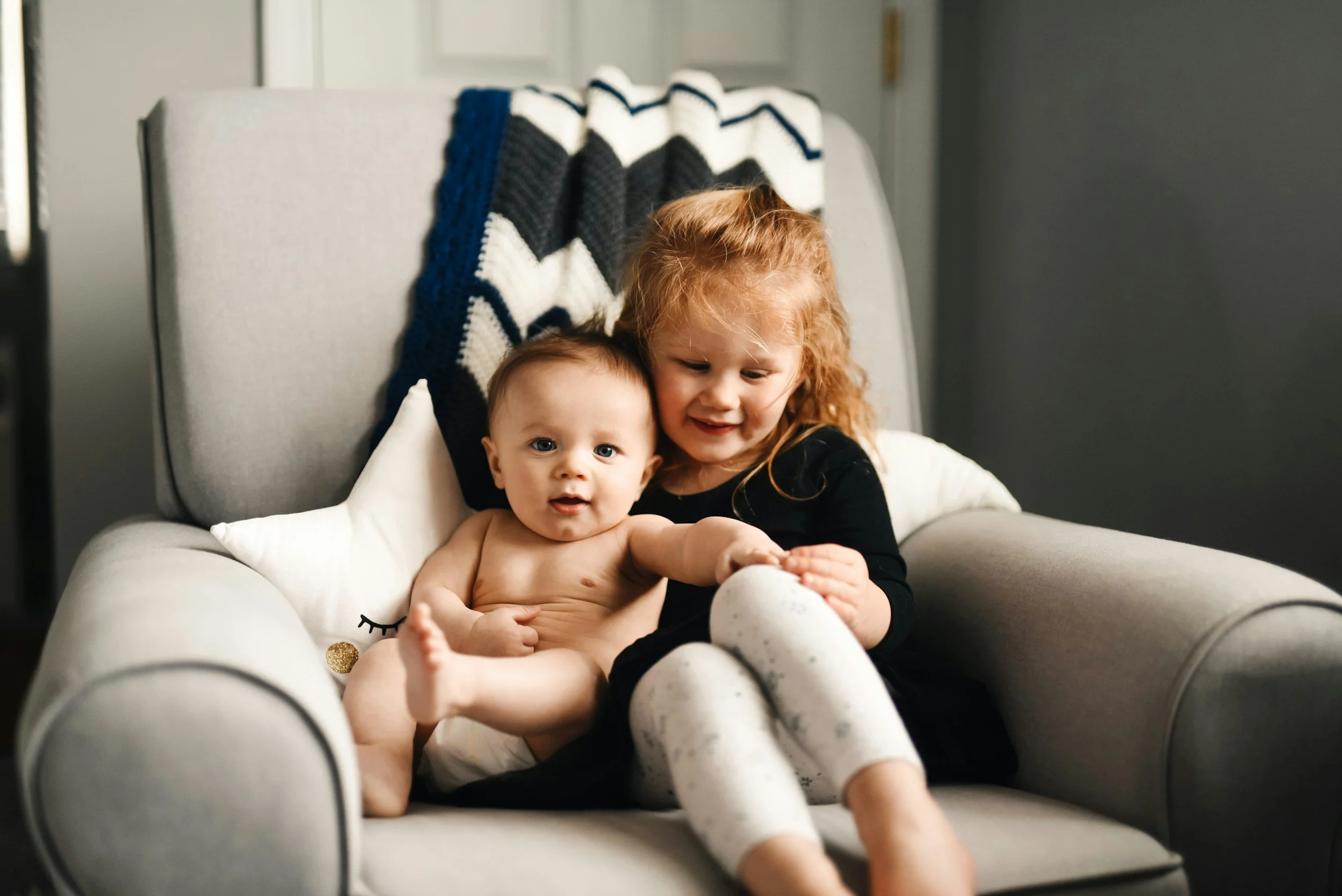
You bring the new baby home and suddenly your previously somewhat-independent three-year-old wants you to do everything for them. They want to be carried. They want you to feed them. They start waking up at night again. Maybe they have toileting accidents after months of using the potty successfully. They are whining more, hitting more, having enormous tantrums over seemingly insignificant things, or becoming incredibly demanding every single time you try to do something with the baby.
For parents, this can be a particularly frustrating response to the arrival of a new sibling. You have probably spent months trying to prepare your child. You read books about becoming a big brother or sister. You let them feel the baby kick. Maybe they helped decorate the nursery and picked out a special gift for the baby. They seemed excited!
And they probably were excited. But being excited about having a new sibling and struggling tremendously when that sibling actually arrives are not mutually exclusive.
For most children, and especially toddlers, the birth of a new sibling is an enormous life transition. Their family has fundamentally changed, their parents suddenly have less time and attention available, their routines may be disrupted, and this new little person appears to have an uncanny ability to make Mom or Dad immediately stop whatever they are doing whenever they make a noise. Even when a child or toddler loves their new sibling, they may have some pretty big feelings about all of this.
Unfortunately, toddlers, and even some older children, are not particularly well known for calmly sitting down to discuss complicated feelings.
A Really Big Change
Imagine for a moment that your partner came home one day and announced that they had some exciting news. They love you so much that they've decided to bring home another partner!
Don't worry. You're going to love them.
In fact, you're going to be a big partner now, which is very exciting. You can help the new partner learn how things work around the house. Also, your partner is going to be extremely busy taking care of this new person for the foreseeable future, so they need you to be patient and independent. You are, after all, the big one.
Most adults would have some feelings about this arrangement.
Obviously, having a sibling is not the same thing as your spouse bringing home another romantic partner, but sometimes thinking about it this way helps us understand just how dramatically a toddler's world has changed. From their perspective, this new person has suddenly entered one of the most important relationships in their life.
Toddlers are also still developing the cognitive ability to understand complicated ideas like, Mom can love the baby enormously and still love me exactly as much as she did before. Love, attention, and time can feel like very concrete resources. If Mom is holding the baby, she isn't holding me. If Dad is changing the baby's diaper, he isn't playing cars with me.
Your toddler may not be able to explain this to you, but they certainly experience it.
Behavior Is Communication
When toddlers don't have the words or developmental capacity to explain what is happening internally, they tend to communicate through their behavior.
A toddler probably isn't going to say, “I've noticed that since the baby arrived, I have substantially less access to you, and I'm feeling insecure about my place in the family.”
Instead, they may hit the baby.
Or scream while you're feeding the baby. Or suddenly need you to find the exact toy they haven't cared about for six months at the precise moment you sit down with a bottle.
Sometimes parents interpret this behavior as jealousy or attention-seeking, and there may certainly be elements of both. But I think it is helpful to go one step further and ask what the child is actually trying to accomplish through the behavior.
If every time I scream, Mom looks at me, I have discovered a very effective way of getting Mom's attention.
If I hit the baby, Dad immediately comes over.
If I refuse to get dressed, Mom has to spend fifteen minutes helping me.
Children are little scientists. They are constantly developing hypotheses about how the world works and repeating experiments that have produced results in the past. Your toddler is not necessarily sitting in their bedroom developing an elaborate plan to manipulate you into paying attention to them. They may simply have discovered that certain behaviors reliably bring you closer.
And right now, they may desperately need reassurance that you are still available.
“But You’re a Big Kid!”
One of the most common responses to the arrival of a sibling is regression. A child who was sleeping independently suddenly wants a parent beside them. A potty-trained child starts having accidents. A child who can absolutely feed themselves wants to be spoon-fed. Some toddlers begin using baby talk, crawling around the house, asking for bottles, or wanting to be held like a baby.
This can be confusing for parents because we know the child is capable of doing these things themselves. It may even feel like they are intentionally making life harder at exactly the moment you have the least amount of energy available.
But think about what your toddler has been observing. The baby cries and gets picked up. The baby gets fed. The baby gets carried everywhere. The baby wakes up at 2 a.m. and Mom comes running.
Being a baby suddenly looks like a pretty effective way to get your needs met.
There can be a lot of pressure placed on a child to become “the big kid” after a sibling arrives. They may hear about how grown-up they are and how much the baby needs them. Usually, adults mean this as encouragement, but your toddler might not be particularly interested in being the big kid right now. Being little seemed to be working out pretty well until someone even littler showed up.
Allowing some temporary regression does not mean your child will want you to spoon-feed them until college. Sometimes children need an opportunity to check that the nurturing and care they received when they were smaller is still available to them.
Love and Anger Can Coexist
Parents can also become concerned when their toddler expresses anger toward the new baby. Maybe they say they don't like the baby. They ask when the baby is going back. They try to push the baby away or become angry whenever someone holds them.
It can be tempting to respond with, “You don't mean that! You love your baby sister!”
But maybe, at that particular moment, they don't.
Children can love their sibling and also wish that sibling had never arrived. They can think the baby is adorable and be furious that the baby interrupted story time. They can want to help with the baby's bath and then become angry when Mom can't play because the baby needs to eat.
Adults have mixed feelings about people we love all the time. Toddlers do too.
When we immediately correct those feelings, we may inadvertently communicate that only the loving, excited, proud big-sibling feelings are acceptable. Instead, we can help put words to the less comfortable ones.
“You really wish it could just be you and me right now.”
“You don't like when I have to stop playing to help the baby.”
“You wanted me all to yourself.”
Accepting the feeling does not mean accepting unsafe behavior. If your toddler tries to hit the baby, you still need to stop them. You might say, “You're really mad that I'm holding the baby, but the baby is not for hitting. You can hit this pillow.”
The anger is allowed. Hurting the baby is not.
Don't Make Everything About the Baby
One small change can make a surprisingly big difference in how we talk to toddlers after a sibling arrives.
Imagine your child asks you to play while you're feeding the baby. You respond, “I can't right now because I have to feed the baby.”
Later, they want you to pick them up. “I can't hold you because I'm holding the baby.”
Then they want help finding something. “You need to wait. I'm changing the baby.”
From your toddler's perspective, there seems to be a common denominator standing between them and everything they want.
Sometimes you can simply change the language. “My hands are busy right now. I can help you when I'm finished.” The limit is exactly the same, but the baby doesn't always have to be the reason your child can't have access to you.
It can also be useful for the baby to “wait” sometimes. Obviously, this should only happen when the baby's needs can safely wait for a moment, but your toddler benefits from occasionally hearing, “Baby, you'll have to wait for a minute. I'm helping your brother right now.”
The baby will have absolutely no idea what you are talking about.
Your toddler will.
Connection Before Correction
When behavior increases after the arrival of a sibling, our natural instinct is often to focus on stopping the behavior. We want the hitting to stop, the tantrums to decrease, and the child to go back to sleeping in their own bed.
Limits are important, especially when safety is involved. But if the behavior is communicating insecurity, disconnection, or a need for reassurance, consequences alone may not address what is actually happening.
Try looking for small opportunities for connection that don't involve the baby. This does not need to mean planning elaborate outings or finding an extra hour every day when you already have a newborn. For a toddler, ten minutes of genuinely focused attention can be incredibly meaningful.
Let them choose what to play. Put your phone away. Follow their lead. Resist the temptation to teach, quiz, or correct. If they want you to drive the same toy car across the floor forty-seven times, drive the car.
In child-centered play therapy, we place a tremendous amount of importance on allowing children to lead. Children spend most of their lives following adult schedules, directions, and expectations. Giving them a small amount of time where they get to decide what happens can provide a powerful experience of control and connection, especially when so much of their world has recently changed.
Play May Change Too
You may also notice the new baby appearing in your toddler's play.
The dolls might suddenly spend a lot of time being fed, changed, rocked, or put to bed. Your toddler might stuff a doll under their shirt and announce that there is a baby in their belly. They may play out the baby's birth or repeatedly have a parent leave one child to take care of another.
Their play may not always be nurturing. The baby doll might get thrown across the room. It might get locked in a box. A dinosaur might eat it.
Understandably, that can be a little alarming.
But play gives children an opportunity to experiment with the experiences, feelings, and relationships they are trying to understand. A toddler can love their actual baby brother and still need to throw a baby doll across the playroom. They may be experimenting with anger, power, jealousy, caregiving, separation, or what it means to be the baby versus the big kid.
As a play therapist, I wouldn't see one baby doll getting eaten by a dinosaur and assume I know exactly what that means. I would pay attention to the larger pattern of the child's play and stay curious about what they are working through.
Give Them Time
The arrival of a sibling isn't one event that your toddler adjusts to the day you bring the baby home. Their relationship with the baby continues to change as the baby grows. The newborn who mostly slept eventually starts smiling at everyone. Then they start grabbing toys. Then crawling. Eventually, this person can walk right over and destroy the block tower your toddler spent twenty minutes building.
There may be periods when things seem to settle down followed by new struggles as the sibling relationship develops. That doesn't necessarily mean something has gone wrong.
Your toddler is learning how to be a sibling at the same time that they are still learning how to regulate emotions, tolerate frustration, share attention, communicate their needs, and understand relationships. That's a lot to ask of a very small person.
For families looking for a child therapist in San Luis Obispo or parenting support on the Central Coast, significant behavior changes following the arrival of a sibling can sometimes be a sign that a child needs additional support navigating the transition. Child-centered play therapy gives young children a developmentally appropriate way to work through changes in their family, experiment with feelings of power and control, and communicate experiences they may not yet have the words to explain.
Your toddler can adore the new baby and have a really hard time with the fact that the baby exists.
Both can be true.
References
Landreth, G. L. (2012). Play Therapy: The Art of the Relationship (3rd ed.). Routledge.
Bratton, S. C., Landreth, G. L., Kellam, T., & Blackard, S. R. (2006). Child Parent Relationship Therapy (CPRT) Treatment Manual: A 10-Session Filial Therapy Model for Training Parents. Routledge.
Dunn, J., & Kendrick, C. (1982). Siblings: Love, Envy, and Understanding. Harvard University Press.
Volling, B. L. (2012). Family transitions following the birth of a sibling: An empirical review of changes in the firstborn's adjustment. Psychological Bulletin, 138(3), 497–528.
Volling, B. L., Gonzalez, R., Oh, W., Yu, T., Rosenberg, L., Song, J. H., Thomason, E., Kuo, P. X., & Stevenson, M. M. (2017). Developmental trajectories of children's adjustment across the transition to siblinghood: Pre-birth predictors and sibling outcomes at one year. Monographs of the Society for Research in Child Development, 82(3), 1–216.